
HC Tygri Cernosice (2006-2008)
Ondra started playing both hockey and football at the age of six, following his older brothers. In Cernosice, he was coached by Jiri Kulicek, a former national-team goalie and an Olympic and World Championship medalist. Ondra was not seen as an extraordinary talent, but when the coach told the players at the end of first grade to do 3x10 push-ups, squats, and sit-ups every day over the holidays, he did it almost every day. I rarely had to remind him in the morning. I taught him that if a drill is supposed to go to the blue line, and he wants to be better than others, he needs to skate one meter past it, not stop one meter before it. That approach comes from athletics, and we both followed it all our lives.
HC Kobra Prague (2008-2016)
After the team in Cernosice broke up, about half moved to Hvezda and Ondra's group moved to Kobra. Both are smaller Prague clubs where talented players from nearby towns mix with players no longer wanted by Sparta or Slavia. It creates an interesting environment. Again, he was lucky with his coach: for the entire period he was coached by Petr Hrbek, probably one of the most skillful hockey players Czechia has ever had, and a person who clearly understands how to coach youth hockey in the Czech system. From the beginning, he taught the boys to play in tight spaces, which later made Ondra's adaptation in the USA much easier. Most importantly, Mr. Hrbek protected both Ondra and me from any agent pressure, even when Ondra fought his way through every selection level up to the Czech national team. In the final season (2015/16), Ondra and the younger U18 team were promoted to the top Czech league. Mr. Hrbek is also an Olympic and World Championship medalist. Ondra remembers this period as follows: "I spent 8 years at Kobra, almost half of my hockey career so far. I look back on my time in Branik very fondly, because those were simply some of the best years of my life and career. I had the honor to play for coach Hrbek, who taught me a lot both on and off the ice, and I owe him for my progress so far. I also had the best teammates a player could wish for. Every day I looked forward to practice, to our group, and to improving a little and being better than yesterday. Kobra is a place I always love to return to."
HC Sparta Prague (2016-2016)
On the recommendation of the Czech U17 coach at the time, Mr. Haken, Ondra had to go on loan to Sparta to play in the top U18 league. As a second-tier player (even though he was also playing for juniors at that time), he would not have been selected for the absolutely key tournament for young hockey players dreaming about a North American career (by Hlinka or U20 Worlds, it is often already late). That tournament was the World U17 Hockey Challenge in Sault Ste. Marie on the Canadian-American border. Before that, Ondra played with U17 in Dallas at Tournament 5 in August 2016. He came back fully excited and determined to go to the USA to play hockey and study, and aligned everything to that goal. That is why he accepted what had previously seemed unthinkable: leaving HC Kobra. He spent less than three months at Sparta under coach Zemlicka.
He performed very well at the U17 WHC tournament. Coach Haken put together the line Pekar-Pavel-Koblizek, rated as one of the best lines in the event. But since Pekar was already in the USA, Ondra followed him soon after, and Tomas K. one year later, and they were never allowed to play together again. Their best game was against Team Canada Black. We lost, but Ondra scored two goals in front of roughly 300 scouts from universities, junior leagues, and NHL organizations. About a month later, an offer arrived.
Iowa Wild U16 (2016-2017)
On the last day of November 2016, we got an offer from a team in Iowa saying they wanted Ondra and that we had only a few hours to decide, basically the time difference between Des Moines and Prague. Universities were primarily interested in him (I think around seven scouts liked him at that time), and that attention triggered interest from Iowa clubs. I will never forget picking him up at the gas station/McDonald's in Prague Smichov and telling him. He consulted coach Hrbek and decided to accept. We had no idea where exactly he was going, what level he would play, or how he would be taken care of. We even thought he might leave after New Year and still spend Christmas at home. Only after confirming the offer did they tell us there was an important tournament in Detroit on December 16, 2016, and they wanted him there already because it would help him. So we had one week to arrange visa, transfer, school, flights, and everything else. We still managed to organize a farewell party, including an early Christmas, and on December 12, 2016 at 6 a.m. we said goodbye at the airport. I wished him not to come back for good, only to visit. He missed a flight in Atlanta, did not speak English well yet, but handled it. He was first placed with a host family with another same-age hockey player, but they left for Christmas after a few days. So they moved him to a young married couple connected to two teammates for Christmas, and that turned out to be the best possible outcome. They grew very fond of him and he stayed there until the end of the season. They took excellent care of him and he spent his first Christmas in the USA with them. We are still in touch, and they even came to the 2020 World Juniors in Ostrava, where they cheered for Ondra and us even in the game against Team USA. His first American coach was the first coach he ever had without an Olympic or World Championship medal, I often teased him about that. That is why I wrote above that his previous Czech coaches had such medals. It also shows how important it is to be lucky with good coaches in youth years.
Youth competitions in the USA are organized so NHL and university scouts can watch players as easily as possible. That is why the first months in the USA were constant tournaments that led to other tournaments, and so on. After the season there were more events, playing for different teams in various tournaments and showcases. It took me a long time to fully understand the U.S. hockey system. With Ondra, we went through it from the very bottom all the way to the absolute top, something likely no Czech player had done before. It was also crucial that he managed the transition from a Czech grammar school to an American high school arranged by his Iowa club.
Minot Minotauros (2017-2018)
In his very first (partial) season in the USA, Ondra attracted scouts from several junior teams. Nobody selected him to USHL yet, so he was drafted to NAHL by a team from North Dakota. The two highest junior leagues in the USA are USHL (Tier 1) and NAHL (Tier 2). Each is run differently and with slightly different rules. What matters is that there is no promotion or relegation between them. That gives teams the stability needed for long-term player development in two-to-four-year cycles. Age categories also overlap, which is still hard to imagine in our environment. Every young player develops physically and mentally at a different pace, so at 18 a player can still be in U18, in junior hockey, or for top talents already in NCAA D1, and in all cases age-eligible. To explain why being in the USA or Canada matters for a boy or girl aiming for university hockey or NHL, let me add one note. It is not mainly about whether one junior league is stronger than another (which is often debated here), but about being seen by as many people as possible, as often as possible. In Czechia, with all respect, this simply cannot be arranged at that scale. Ondra was selected because their scout noticed him by chance at a tournament where he was actually scouting another player. He walked past a different rink, saw a player win a faceoff, kept watching, and after that player (Ondra) won five faceoffs, he wrote his name in his notebook. Then in the draft, when they got to round eight and had no clear target left, he was still available, so they picked him.
Ondra started in the team as an extra player and gradually worked his way to third-line center. In the end, as the youngest player in the lineup, he scored the overtime winner in the Robertson Cup semifinal and sent his team to the final. To this day, it is still the most famous goal in club history and can surely be found on YouTube. This was also the first time they used him regularly against opponents' top lines and on penalty kill. He finished high school in Iowa remotely and graduated one year earlier than he would have in Czechia. That year, Ondra also played 13 seconds at the Ivan Hlinka tournament when we were losing the semifinal against Russia. Coach Bruk sent him out to win a key faceoff, from which we tied the game. In the final, Canadians were looking for him in the lineup, and one of them asked me where he was and why he was not playing. Only after the tournament did we hear that he had supposedly had too few "positive puck exits" in camp. He needed a long time to recover mentally from that, and in hindsight it was actually good that he was effectively blacklisted and stopped being called to national-team events. It was the era of "Dukla" Litomerice and the federation's obsession with one specific Czech development path. If you were abroad and did not have a well-connected local agent, you were treated as if you did not exist. But he no longer needed the national team for anything; he was building his reputation through daily work on and off the ice in the USA.
Fargo Force (2018-2020)
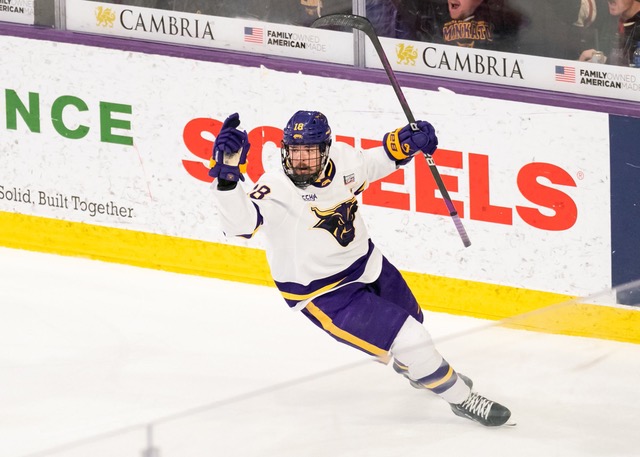
After his second excellent season in the USA, he was drafted by Fargo Force to USHL. Again, he started in the stands as a non-playing extra and gradually developed into their third-line center. Several of his legendary fights from that period are still available at https://www.hockeyfights.com. In his second season there, his teammates elected him captain. He became the first Czech in the history of American junior leagues to wear the captain's "C". The team was on track to win the Clark Cup, but unfortunately COVID ended the season one month after the 2020 World Juniors in Ostrava, and Ondra returned home. Since summer 2018, interest from U.S. universities had kept growing. After a longer selection process, he chose Minnesota State University and signed his NLI in November 2019. You may have noticed that in that same season, after passing all camps, he surprisingly made the final Czech roster and played at the U20 World Championship in Ostrava.
Minnesota State University Mankato (2020-2023)
This part of the journey has already been described in detail on social media. Once again, he started in the stands, but still managed to play 11 regular-season games in his first year. Former MSU coach Mike Hastings, a coaching legend who regularly coaches Team USA at Worlds and Olympics, played an old-school physical power style where freshmen were not used much. In the second season, when he played all games, the team reached the Frozen Four final for the first time in program history. Before the final, he was shown on the Boston Bruins arena jumbotron as one of MSU's two difference-makers. They unfortunately lost to Denver University. After the season, NHL interest was already real. One team even made him an offer, but Ondra decided to stay one more year at MSU. Completing his degree remained an important goal, and two years in AHL/NHL would have made finishing school difficult. During that season, journalists described him as one of the best defensive forwards in NCAA hockey history.
Colorado Avalanche / Colorado Eagles / Milwaukee Admirals (2023-2025)
In the end, Ondra was choosing from several NHL offers. I texted him after the season, but he did not tell me anything because he knew I would probably brag somewhere. He followed the rule that such decisions are not discussed during playoffs, so I was very nervous about the outcome. The Avalanche offer was the best, especially in terms of realistic chances to reach the first team quickly. He did everything he could, but managed to play only two NHL games. As always, a bit of luck is part of it too. Unfortunately, Ondra was injured twice shortly before main camp and never completed it. Getting to the NHL roster during the season is much harder. In December 2024, he was traded to Nashville Predators' farm system, but the path to the first team did not open there either. So after finishing his entry-level contract, Ondra moved to Europe.
Tappara Tampere (2025/2026)
From many offers, he chose Tappara Tampere, the top Finnish hockey organization. Freedom of choice is the most valuable thing you can gain from a journey like this. We will see what comes next.